Shake-table tests on moment-resisting frames by introducing engineered cementitious composite in plastic hinge length
Abstract
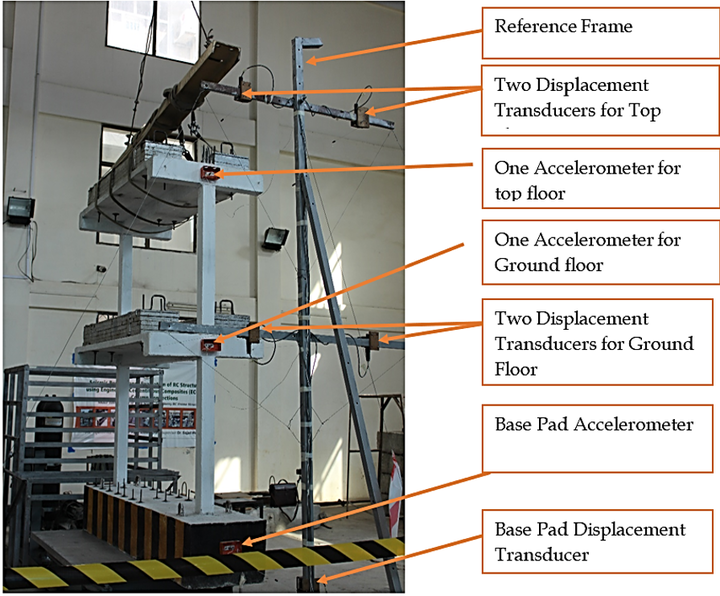
This paper presents experimental studies on reinforced concrete moment resisting frames that have engineered cementitious composite (ECC) in plastic hinge length (PHL) of beam/column members and beam-column joints. A two-story frame structure reduced by a 1:3 scale was further tested through a shake-table (seismic simulator) using multiple levels of simulated earthquake motions. One model conformed to all the ACI-318 requirements for IMRF, whereas the second model used lower-strength concrete in the beam/column members outside PHL. The acceleration time history of the 1994 Northridge earthquake was selected and scaled to multiple levels for shake-table testing. This study reports the observed damage mechanism, lateral strength-displacement capacity curve, and the computed response parameters for each model. The tests verified that nonlinearity remained confined to beam/column ends, i.e., member joint interface. Calculated response modification factors were 11.6 and 9.6 for the code-conforming and concrete strength deficient models. Results show that the RC-ECC frame’s performance in design-based and maximum considered earthquakes; without exceeding maximum permissible drift under design-base earthquake motions and not triggering any unstable mode of damage/failure under maximum considered earthquakes. This research also indicates that the introduction of ECC in PHL of the beam/column members' detailing may be relaxed for the IMRF structures.

Muhammad Rashid
Postdoctoral Research Associate
My research interests includes finite element modeling and probabilistic seismic performance and fragility assessment of structural systems under cascading earthquake hazards.