Mainshock–aftershock seismic fragility assessment of civil structures: A state-of-the-art review
Abstract
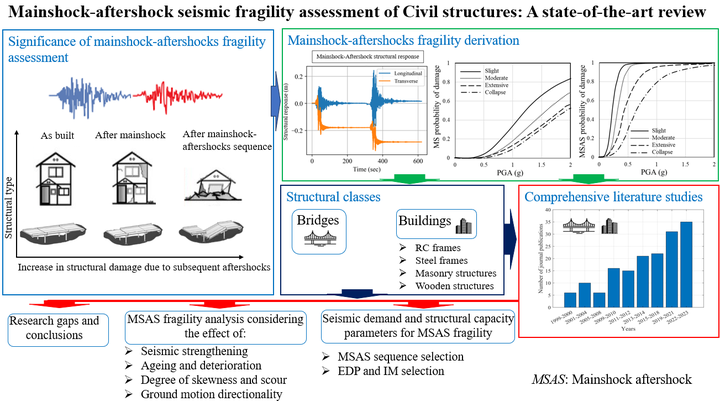
Sequential seismic events occur worldwide, which impose significant threatsto the safety and serviceability of Civil infrastructure, especially buildings andbridges. Fragility functions are imperative to support decision‐making tools forpotential seismic risk identification and its impact on structural performanceduring sequential earthquakes. The increasing number of publications shows anotable increase in interest among researchers and the scientific communityin this domain. This study presents a systematic review of available resourcesand techniques for structural performance and fragility evaluation subjected tomainshock–aftershock seismic loading. Efforts have been made to focus on thesalient features of various approaches rather than criticizing the mathematicalframeworks and associated analysis approaches. Existing knowledge related tothe effect of sequential seismic loading on buildings and bridge infrastructuresand their fragility estimates is presented concisely. The paper concludes bydetailing the opportunities for future developments in the fragility analysis ofCivil infrastructure under sequential seismic hazard. This would encouragestakeholders and decision‐makers to put into practice their applications forrisk mitigation, recovery planning, and well‐informed decision‐making.

Muhammad Rashid
Postdoctoral Research Associate
My research interests includes finite element modeling and probabilistic seismic performance and fragility assessment of structural systems under cascading earthquake hazards.